
How many cannabis social clubs are there in Spain?
The most up-to-date estimates point to more than 800 active cannabis associations in Spain in 2025. There is no unified official register: clubs register in generic regional registers without any specific category. The highest concentration is in Catalonia (over 200 in Barcelona alone), followed by the Basque Country (between 77 and 150 registered) and Madrid (estimated at around 100). At the historical peak in the mid-2010s, between 800 and 1,200 were recorded nationwide.

This is one of the questions with the hardest answer to verify across the entire Spanish cannabis sector. Not because clubs do not exist, but because no official authority counts them.
In more than ten years working as a lawyer specialising in cannabis law, I have seen this figure used in vastly different ways: to justify regulation, to argue a lack of control, and for everything in between. What I can provide here is what I know with certainty: verifiable data, its context, and what it means in practice.
The data in figures: what we know with certainty
When someone asks me how many clubs there are in Spain, the first thing I say is: nobody knows exactly, and that in itself is vital information. Clubs are registered in the Register of Associations of each autonomous community under Organic Law 1/2002, without any specific category identifying them as cannabis associations. From a registry perspective, a cannabis club and a residents’ association have the exact same type of registration. This makes it impossible to extract an exact figure without manually reviewing each regional register, which no one has done systematically.
Where are the most cannabis clubs in Spain? Breakdown by autonomous community
The geographical distribution of clubs in Spain is highly uneven. There are autonomous communities with deep-rooted historical traditions dating back to the 1990s, and others where the phenomenon is relatively recent. This influences both the number of clubs and the stance taken by local authorities towards them.
| Autonomous community | Estimated clubs | Relative concentration | Notable context |
|---|---|---|---|
| Catalonia | +250 (212 in Barcelona alone) | Highest concentration in Spain. Barcelona Special Urban Plan (2016) annulled by TSJC. 30 closures ordered in 2024. | |
| Basque Country | 77–150 registered | Historical birthplace of the movement. Pannagh (Bilbao, 2003), the most influential association. EUSFAC brings together the Basque federations. | |
| Madrid | ~100 estimated | Accelerated growth over the last decade. No specific municipal ordinance. | |
| Valencia | ~60–80 estimated | Sustained growth. Notable presence in Valencia city and Alicante. | |
| Andalusia | ~50–70 estimated | Seville and Malaga account for the majority. In the 1990s, the Regional Government of Andalusia drew up one of the first reports supporting the CSC model. | |
| Navarre | ~30–50 estimated | Foral Law 24/2014 annulled by the Constitutional Court (STC 144/2017). Associative tradition predating the law. | |
| Rest of Spain | ~200–300 estimated | Aragon, Galicia, Canary Islands, Balearic Islands, Castile and León, and other regions. Growing presence, but without significant concentration. |
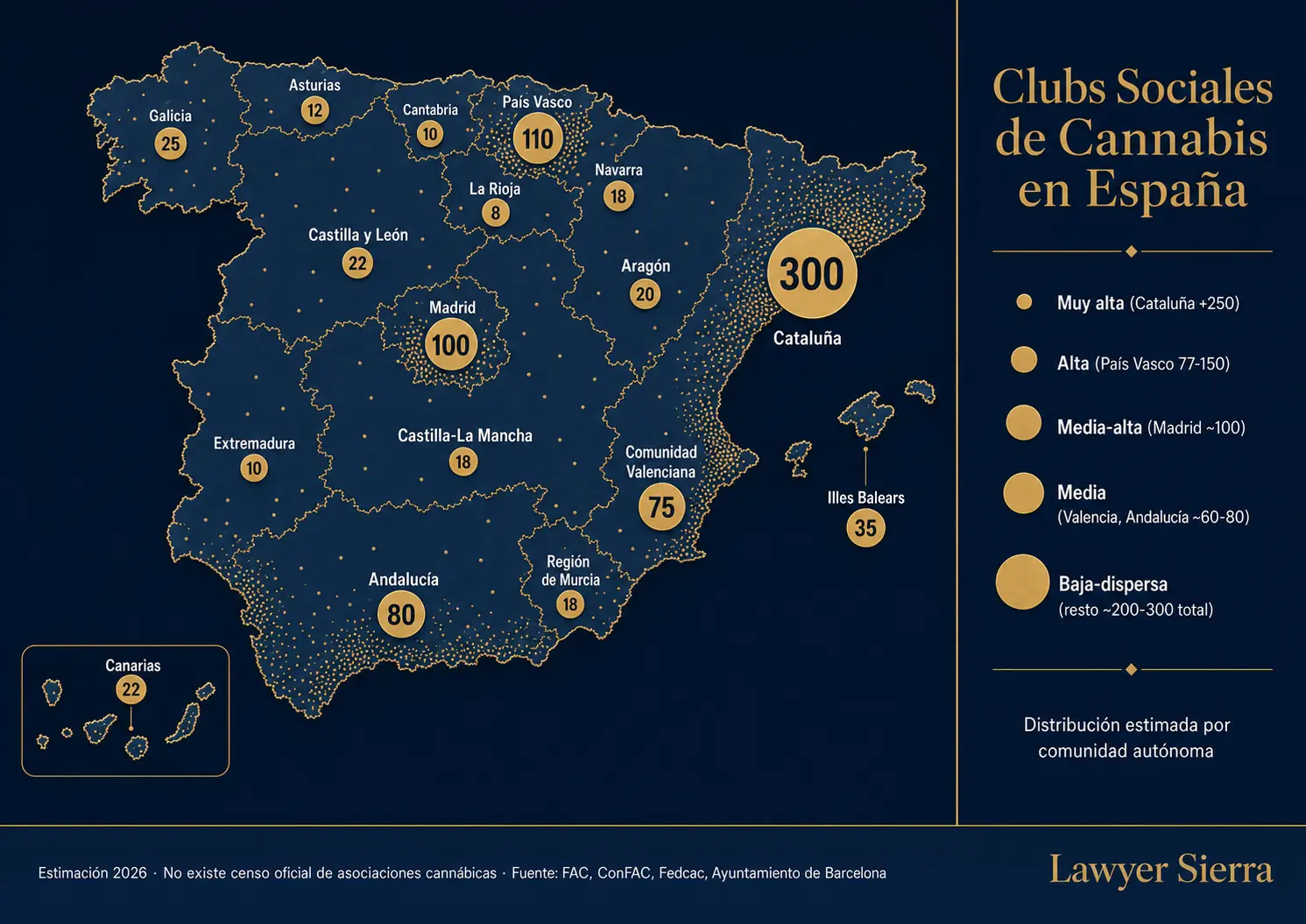
Estimated distribution of cannabis social clubs in Spain by autonomous community. Data based on sector sources (FAC, ConFAC, Fedcac, EUSFAC) and available municipal data. There is no official nationwide register. 2026 estimate.
Why Barcelona concentrates so many clubs
Barcelona did not come to have more than 200 clubs by chance. A combination of historical, cultural, and administrative factors explains this.
The associative cannabis movement was born in Catalonia: ARSEC (1991) and the Barcelona Cannabis Tasters Club (2001) were the pioneers. A comparatively more tolerant stance from Barcelona’s municipal council over many years, alongside the attempt at regularisation through the 2016 Special Urban Plan, created an environment perceived as safer for establishing clubs.
Cannabis tourism was also a growth factor, which ultimately became an issue: the massive arrival of visitors drawn by the clubs contradicted the principle of a closed circle of prior consumers, serving as one of the arguments used by the new municipal administration to intensify inspections in 2024.
What happened in Barcelona is a very clear example of how uncontrolled growth ends up generating the opposite effect to what was intended. When a private associative model turns into a tourist attraction, it loses precisely what protects it legally: its closed nature, prior acquaintance among members, and the absence of active solicitation. In many Barcelona clubs, this ceased to be observed long ago, making the reaction of the municipal authorities in 2024 somewhat predictable. You cannot expand without controls and expect nobody to notice.
How we got here: historical evolution in figures
The number of clubs in Spain was not always what it is today. Its evolution reflects with precision how each legal or political milestone has directly impacted the sector.
The origin: ARSEC and the Catalan breakthrough
The Ramón Santos Association for Cannabis Studies (ARSEC) is founded in Barcelona. The first cannabis association in Spain, though not yet a social club in the strict sense. It lays the groundwork for the model.
The Basque breakthrough: Kalamudia
The Kalamudia association organises the first major collective plantation in Bilbao (600 plants for 200 members). The cultivation survives and sets the Basque precedent for the CSC model.
The first formal CSC: Barcelona Cannabis Tasters Club
The first cannabis social club defined as such in Spain. From this point on, the associative model begins to spread tentatively.
Pannagh: the club that changed everything
The Pannagh Association is founded in Bilbao. Registered in the Register of Associations of the Basque Country (No. AS/B/10623/2003). The judicial return of 17 kg of cannabis in 2007 following a police intervention becomes an international symbol of the movement. FAC is established.
~40 clubs across the country
The movement remains small. The model is presented at the European Parliament to officials from the Anti-Drugs Coordination Unit of the European Commission.
Boom: estimated 600–1,200 clubs
Massive expansion driven by the economic crisis and increased visibility of the model. Catalonia registers 72 new associations in 2012 alone. In 2014, between 600 and 1,200 are estimated across Spain.
Turning point: Supreme Court Judgment STS 484/2015
The Plenary of the Second Chamber of the Supreme Court establishes the five criteria determining when a club operates lawfully. The effect is immediate: many clubs that fail to meet these criteria face real criminal liability.
Current situation: +800 estimated clubs
Stabilisation of the sector following closures in Barcelona (2024) and heightened case-law pressure in 2023. More than 800 associations remain active, but under greater scrutiny than ever before.
Why is there no official register of cannabis clubs in Spain?

This is the question that most surprises those who begin researching the subject. The answer lies in the legal architecture of the model.
Cannabis social clubs are established pursuant to Organic Law 1/2002 governing the Right of Association. Upon registration, a cannabis association states its aims in generic terms, without any requirement or possibility of identifying itself as a “cannabis social club” in the register. They are simply “associations”, on the same legal footing as a sports supporters’ club or a cultural association.
This carries significant practical consequences. Any figure cited regarding the number of CSCs in Spain is, at best, an estimate based on partial data from sector federations or specific municipal reviews, such as Barcelona’s. No public body holds this data, nor is there any obligation to report it.
What this means if you want to set up a club
The absence of an official register does not mean authorities are unaware of your existence. In practice, the police, the public prosecutor’s office, and the courts have access to regional registers of associations and can identify cannabis clubs through their articles of association, premises location, or activities. Not being listed in a “CSC register” affords no additional protection.
Some believe that the lack of an official register of cannabis clubs affords them greater protection. It is quite the opposite. What provides protection is operating lawfully, having all documentation fully compliant, and meeting the Supreme Court’s criteria. The absence of an official register simply means nobody knows exactly how many clubs exist, not that those operating are invisible to the authorities.
Do you want to understand what a cannabis social club actually is before taking any steps?
What is a cannabis social club in Spain?What the figure reveals about the true state of the sector

More than 800 active clubs in 2025, after decades of case-law pressure and without any statute expressly endorsing them, speaks to the resilience of the model: it has endured because it addresses a genuine need and because, when operating properly, it finds accommodation within the existing legal framework.
Yet the number also obscures a more complex reality. Not all 800 clubs operate with the same standard of diligence. There are clubs that have operated for decades with full legal compliance and impeccable documentation. And there are clubs that exist formally but fail in practice to meet the Supreme Court’s criteria. The headline figure makes no distinction between the two.
For those considering incorporating a club or reviewing whether their existing entity meets the requisite standards, the total number of clubs in Spain is an interesting yet secondary point. What truly matters is whether that specific club operates within the boundaries of legal tolerance. The correct formation process is detailed in how to set up a cannabis social club in Spain, and if you already operate one, our compliance and criminal risk prevention service for CSCs is the essential starting point to ensure your premises and operations remain legally sound.
Does your club operate with genuine legal certainty? Do you want to verify this before an inspection uncovers issues?
Compliance analysis for CSCsDo you have questions about your club or wish to incorporate one with full legal guarantees?
More than ten years working in this sector have taught me that accurate information, delivered in good time, makes all the difference.
Speak with Gabriela SierraFrequently asked questions about the number of cannabis clubs in Spain
Can I search the register of cannabis associations in my autonomous community?
Yes, but there is no specific “cannabis association” category. Each autonomous community maintains its own Register of Associations under the competent regional ministry (typically Interior or Justice). Cannabis associations are listed alongside all others, without any differentiating tag. Locating them requires reviewing the articles of association of each registered entity, a task that is neither systematised nor automated.
Can two cannabis clubs operate in the same building or on the same street?
There is no national regulation establishing minimum distances between clubs. However, several municipalities have enacted local ordinances governing separation distances between premises of this kind, alongside required distances from educational centres, healthcare facilities, or areas frequented by minors. In Barcelona, for instance, municipal regulations under review in 2024 set out distance criteria between clubs. Before committing to premises, it is essential to check the specific municipal regulations of the municipality in question.
Which federations represent cannabis clubs in Spain?
The primary organisations are the Federation of Cannabis Associations (FAC), established in 2003 and among the first to coordinate the sector’s legal strategies, and the Confederation of Federations of Cannabis Associations (ConFAC), which brings together regional federations. In Catalonia, Fedcac (Federation of Self-Regulated Cannabis Associations of Catalonia) is prominent, as is EUSFAC in the Basque Country. These federations hold no official administrative status and confer no additional legal protection upon clubs, but they represent the sector in policy discussions and promote self-regulation.
How many members do cannabis clubs in Spain have in total?
There are no reliable nationwide figures. The only verified data comes from Catalonia, where Fedcac estimated around 165,000 members across the region’s clubs at their peak. In the Basque Country, the 77 clubs registered in regional records accounted for approximately 10,000 members according to EUSFAC. Extrapolating cautiously, the nationwide total could stand between 200,000 and 400,000 members, though this remains an estimate subject to a wide margin of error.
Are there cannabis clubs in the islands (Canary Islands and Balearic Islands)?
Yes, although in fewer numbers than on the mainland. Both the Canary Islands and the Balearic Islands have cannabis associations registered in their respective regional registers. Their presence is most pronounced in Ibiza, Mallorca, and Las Palmas de Gran Canaria, partly linked to tourist activity; however, this raises the same legal issues seen in Barcelona regarding the requirement of a closed circle of prior consumers.
How long has nationwide regulation of cannabis clubs been under consideration?
For more than a decade. Since 2012, successive bills have been introduced in the Congress of Deputies to regulate cannabis social clubs at national level, none of which have succeeded up to 2026. Navarre (2014) and Catalonia (2017) attempted regional statutory frameworks, but the Constitutional Court annulled both statutes for encroaching upon state competences. The debate continues, but sufficient political consensus to pass legislation has yet to materialise.
This article is provided for informational purposes only and is based on available data from industry sources, municipal bodies, and academic publications. Figures regarding the number of clubs are estimates subject to variation. It does not constitute tailored legal advice. For a specific assessment of your situation, consult a qualified specialist.